Atlantis
Atlantis, the fabled lost continent of ancient lore, is revealed to be a tangible reality during a midnight underwater excursion led by Captain Nemo. For Professor Pierre Aronnax, the discovery is the culmination of a lifetime of scientific speculation, transforming a myth debated by philosophers and scientists into a concrete, awe-inspiring landscape of ruins, volcanic fire, and submerged history. The encounter not only validates the accounts of Plato but also deepens the mystery of Captain Nemo himself, who treats this sunken world as his personal domain, a place where he communes with the past and perhaps finds a reflection of his own lost civilization.
Discovery and Description
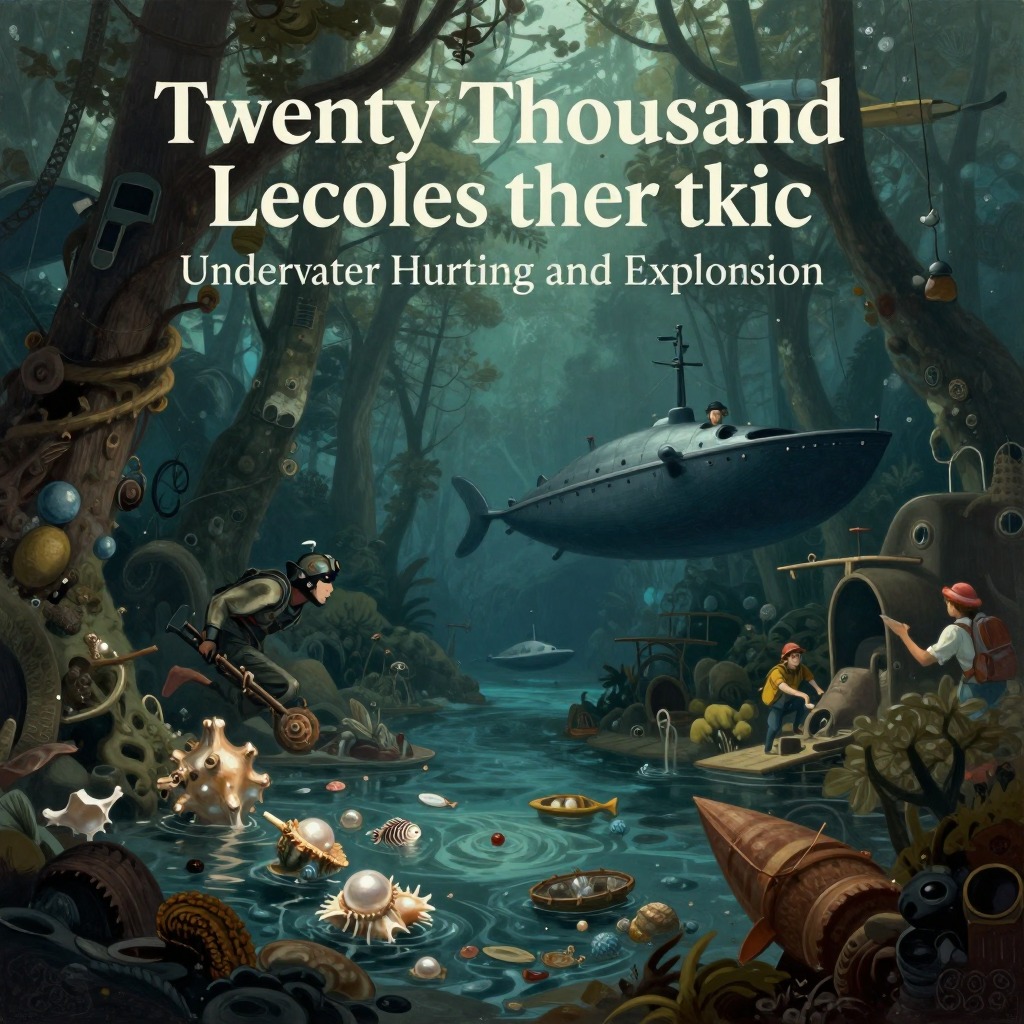
The revelation of Atlantis occurs on the night of February 19, after the Nautilus has retrieved treasure from the Bay of Vigo. Captain Nemo invites Aronnax on an unusual and exhausting underwater stroll, warning him that they will need to walk for long hours and scale a mountain. They descend to a depth of 300 meters, guided by a distant reddish glow that turns out to be an underwater volcano. As they walk, the seafloor changes from slimy mud to rocky terrain, and Aronnax notices a strange symmetry in the piles of stones, as well as gigantic furrows trailing off into the darkness. The path leads them through a petrified forest of dead trees, turned to stone by the action of the water, and up the slopes of a mountain. Upon reaching the peak, Aronnax is confronted with a breathtaking panorama: a vast plain lit by the fiery lava of the volcano's crater, and in the midst of this infernal landscape, the unmistakable ruins of a human civilization. He sees collapsed roofs, demolished temples, dislocated arches, fallen columns, the remains of a gigantic aqueduct, the caked heights of an acropolis, and the remnants of a wharf—a whole Pompeii buried under the waters. Captain Nemo then picks up a piece of chalky stone and scrawls a single word on a black basaltic rock: "ATLANTIS."
Historical and Mythological Context
The name "Atlantis" immediately triggers a flood of associations in Aronnax's mind. He recalls the ancient land of Meropis mentioned by the historian Theopompus, and most famously, Plato's account in his dialogues Timaeus and Critias. According to Plato, the story was passed down from the Athenian lawgiver Solon, who heard it from Egyptian priests in the ancient city of Sais. These priests described a powerful Atlantean empire that existed 9,000 years before Solon's time, a continent larger than Africa and Asia combined, located beyond the Pillars of Hercules (the Strait of Gibraltar). The Atlanteans waged war against ancient Athens and were eventually defeated. Subsequently, a cataclysm of floods and earthquakes obliterated the entire continent in a single day and night, leaving only its highest peaks—the Azores, the Canaries, and the Cape Verde Islands—still emerging above the waves. Aronnax notes that the very existence of Atlantis has been denied by many philosophers and scientists, including Origen, Humboldt, and Malte-Brun, while others like Pliny, Buffon, and d'Avezac have accepted its reality. Now, standing on its soil, Aronnax feels he has the unimpeachable evidence of the catastrophe before his own eyes.
Narrative Role and Significance
The discovery of Atlantis serves multiple crucial functions within the narrative. It is the most spectacular of the many wonders that Captain Nemo reveals to Aronnax, fulfilling his promise to show the professor what no human being has ever seen before. The scene also deepens the enigma of Captain Nemo himself. As Aronnax watches, Nemo leans on a moss-covered monument, motionless as if petrified, lost in a mute trance. Aronnax wonders if the captain is dreaming of those lost generations, asking them for the secret of human destiny, or if this is where he comes to revive himself, basking in historical memories and reliving a bygone life. The discovery reinforces the idea that the ocean floor is a vast repository of history, a library of sunken civilizations and lost treasures that Nemo has made his own. Furthermore, the location of Atlantis directly connects to the Nautilus's subsequent visit to the underwater coalfields, a volcanic cavern that serves as the ship's secret harbor, further emphasizing the volcanic and geological forces that have shaped this hidden world. The entire experience leaves Aronnax in a state of stunned amazement, reinforcing the novel's central theme of the sea as a realm of infinite mystery and wonder, a place where the past is not dead but merely submerged.